Its 4:51 am. I just went to Duff's huge house to drop off his Toyota Land Cruiser and pick up my Ford Ranger to drive it back to my tiny apartment. On the way I start thinking. I hate driving this crappy truck and I start getting down on myself about some other stuff. It wasnt a good trip home. When I get home, I get an email from Brian. I can see the first few words while it is still unopened in my inbox because of how GMAIL is set up. The words I see are Dude, there were some NLers talking about you and... I think to myself, "Great! What did I do wrong now?" I opened the email to find the following message.
Dude, there were some NLers talking about you and the direction of the youth Weds night. They all had awesome things to say about you and where you're taking the teens.
It's coming bro. I think you're doing some great stuff. We all knew you were capable. Just keep it up and God's gonna honor your willingness to serve. Love ya bro.
I sent him back an email with a gladness in my heart that God still speaks prophetically through His servants. Those were the EXACT words I needed in that situation.
So, now...may God speak through you and may you, when He is speaking through you, be an open pipeline to those who need to hear.
Thursday, June 29, 2006


Monday, June 26, 2006
To all of the faithful blogers...big up yourself!
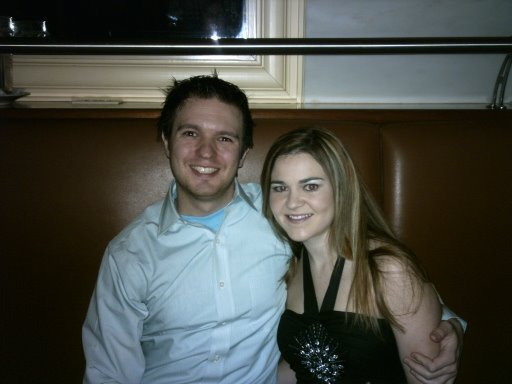 This is me and Becki at our Valentine's dinner at Chez Fon Fon
I think I am back in the world of blogs after reading this post from www.evotional.com. Its the top ten reasons why he posts.
#10 Blogging is a form of digital discipleship. Neo-scrolls.#9 Blogging is the way I share what is happening in my head and my heart.#8 Blogging is cathartic. It helps me process what I'm thinking and feeling.#7 Blogging is the way I leave a trail. My kids and grandkids can read it someday.#6 Blogging is a sermon supplement. Actually, sermons might be a blogging supplment.#5 Blogging is a way to carry on a conversation with lots of people at the same time.#4 Blogging is a form of auto-biography.#3 Blogging is one way of capturing the things God is revealing to me.#2 Blogging helps me remember what God doesn't want me to forget.#1 Blogging is a stewardship issue. It's one way I share what God is teaching me.
So...may you continue your faithful blogging and may your teaching, relating, and living be fuller because of it.
Monday, January 23, 2006
Letting Scripture Read You
Here are some of my thoughts after reading some more in A New Kind of Christian.
What if, instead of seeing the Christian faith like a building (built on one foundation – The Bible) we saw it like a spider web (having many anchors such as spiritual experiences, exemplary people and institutions we have come to trust, and the Bible.)?
What if faith was more like the earth than a building? Faith could never be stable in the way God intended it unless there was come kind of forward momentum and if that momentum was not in the field of the gravity of God. Birds in flight, bicycles, and ships all use movement in relation to larger forces to get their stability.
John Wesley – The church gets its stability from the interplay of Scripture, tradition, reason, and spiritual experience.
Maybe we are working from a much too static model of authority and we need to be called to a higher point of view to see that our situation is much more dynamic, much more predicamental.
Approach the Bible on less defined terms. Instead of approaching it with our modern assumptions and expectations and our aggressive analysis, maybe we need to read it less like scholars and more like humble seekers trying to learn whatever we can from it, in the context of our sincere desire of love for God and do what he wants. I guess that would be the momentum – the desire to do God’s will. Maybe we need to read it with more of that desire and less of our critical analysis. Maybe postmodern is postanalytical and postcritical.
Instead of reading the Bible, let the Bible read you. How does a scientist approach a frog in dissection, a detective at a crime scene, now how is that different from a teenage boy approaching a girl? You would be less aggressive and controlling and more relational. Even further though, what if you were a patient with cancer and you were meeting your oncologist for the first time? What feelings would you have then?
What would happen if we approached the text less aggressively and more energetically and passionately? What if we honestly listen to the story and put ourselves under its spell and instead of going to the text to get our questions about God answered, we went trusting God to use it to pose questions to us about us? What would happen if we just trusted ourselves to it – the way a boy opens his heart to a girl, the way a patient trusts herself to an oncologist? The practice of lectio divina does this.
What if, instead of seeing the Christian faith like a building (built on one foundation – The Bible) we saw it like a spider web (having many anchors such as spiritual experiences, exemplary people and institutions we have come to trust, and the Bible.)?
What if faith was more like the earth than a building? Faith could never be stable in the way God intended it unless there was come kind of forward momentum and if that momentum was not in the field of the gravity of God. Birds in flight, bicycles, and ships all use movement in relation to larger forces to get their stability.
John Wesley – The church gets its stability from the interplay of Scripture, tradition, reason, and spiritual experience.
Maybe we are working from a much too static model of authority and we need to be called to a higher point of view to see that our situation is much more dynamic, much more predicamental.
Approach the Bible on less defined terms. Instead of approaching it with our modern assumptions and expectations and our aggressive analysis, maybe we need to read it less like scholars and more like humble seekers trying to learn whatever we can from it, in the context of our sincere desire of love for God and do what he wants. I guess that would be the momentum – the desire to do God’s will. Maybe we need to read it with more of that desire and less of our critical analysis. Maybe postmodern is postanalytical and postcritical.
Instead of reading the Bible, let the Bible read you. How does a scientist approach a frog in dissection, a detective at a crime scene, now how is that different from a teenage boy approaching a girl? You would be less aggressive and controlling and more relational. Even further though, what if you were a patient with cancer and you were meeting your oncologist for the first time? What feelings would you have then?
What would happen if we approached the text less aggressively and more energetically and passionately? What if we honestly listen to the story and put ourselves under its spell and instead of going to the text to get our questions about God answered, we went trusting God to use it to pose questions to us about us? What would happen if we just trusted ourselves to it – the way a boy opens his heart to a girl, the way a patient trusts herself to an oncologist? The practice of lectio divina does this.
Thursday, January 12, 2006
Where the cross meets the dream catcher
What would you think if you saw a cross and a dream catcher hanging in the rearview mirror of a car? Is that person messed up or is there something messed up in the way we have been presenting the cross?
Wednesday, January 11, 2006
My mechanistic view of God
I was reading A New Kind of Christian ( the book Rob Bell...it all goes back to him doesn't it...haha...and his wife read right before starting Mars Hill) and I was wondering if any of this hit you guys like it hit me.
First off, do you ever think of modernity vs. postmodernity? That is a huge discussion in itself.
Is it possible to have a faith that transcends the historical situation we find ourselves in?
What does it mean to say that God is in control? When we think of the word control, we think of someone controlling a car or a machine. We probably can not think of it without thinking of it mechanistically. But, before the modern world, there were no complex machines. Whatever a person in ancient Biblical times would have meant by saying "God is in control" is almost certainly very different from what we mean today. For that person, God's control was associated with farmers controlling animals or parents controlling children or kings controlling subjects - all very different from an operator controlling a machine.
What would that do to the question of how can God be in control if there is so much evil in the world now that the definition of control has been radically changed? If a driver wrecks a car, then its the drivers fault, but if a child is raised to do right and then when he is older he doesn't, then its not the parents fault. Even though the child is thought to be under his parents control, he is still free to make his own decisions.
That example of control is just the tip of the differences between looking at God through a modern lens and looking at Him through a medieval lens or even a postmodern lens.
What do you guys think?
Bought and OWNED!!! (Romans 1:1, Isaiah 26:8)
G
First off, do you ever think of modernity vs. postmodernity? That is a huge discussion in itself.
Is it possible to have a faith that transcends the historical situation we find ourselves in?
What does it mean to say that God is in control? When we think of the word control, we think of someone controlling a car or a machine. We probably can not think of it without thinking of it mechanistically. But, before the modern world, there were no complex machines. Whatever a person in ancient Biblical times would have meant by saying "God is in control" is almost certainly very different from what we mean today. For that person, God's control was associated with farmers controlling animals or parents controlling children or kings controlling subjects - all very different from an operator controlling a machine.
What would that do to the question of how can God be in control if there is so much evil in the world now that the definition of control has been radically changed? If a driver wrecks a car, then its the drivers fault, but if a child is raised to do right and then when he is older he doesn't, then its not the parents fault. Even though the child is thought to be under his parents control, he is still free to make his own decisions.
That example of control is just the tip of the differences between looking at God through a modern lens and looking at Him through a medieval lens or even a postmodern lens.
What do you guys think?
Bought and OWNED!!! (Romans 1:1, Isaiah 26:8)
G
Subscribe to:
Posts (Atom)


